Basic HTML Version


SUMMER 2012
9
Spring storms
A
nybody who thinks history is
irrelevant should follow closely
the events consuming many
Arab countries at the moment and the
attitudes of Western governments and
commentators to those events. It can be
argued that the West is seeing the
events in terms of its own dominant
theory of history and ignoring the
alternate possibilities.
The Western hailing of the turmoil as a
“Spring” flows from reading the
movements as democratic with all that
connotes in the Western mind: free,
progressive, secular. In turn that flows
from a theory that sees democracy as
the inevitable direction of history. The
Arab world is following us in
demanding freedom and rights.
A little knowledge of history, especially
of history as experienced by Arab peoples,
might allow other possibilities. And
that is not to deny the reality of Western
influences in what is happening.
As a start this is not the first movement
in living memory which owes
something to Western influence. When
European imperial powers such as
Britain, France and Italy withdrew
progressively after World War II from
the sections of the Arab world they had
dominated, Arab thinkers saw the
possibility of the resurgence of Arabic
culture and power to the position of
influence it had known in the Middle
Ages. Coming together in that
movement were memories of the
former greatness of Arab civilisation,
the importation of nationalistic ideas
from the West and a sense of
resentment at the outside powers who
had held them in subjection during the
age of European empires.
Since the great age of Arab power had
been under Islam, that was the model,
yet the movement was not sectarian.
One of the founders was Michel Aflaq,
who was a member of an Arabic-
speaking church whose lineage goes all
the way back to the church of the
Eastern Roman Empire. The aim was
to unite Christian and Muslim, Sunni
and Shi’ite, in a movement whose
characteristics were that it was Arab,
non-sectarian and democratic. Hence
arose Pan-Arabism, the United Arab
Republic and the Ba’ath Party.
What happened to that great dream?
Saddam Hussein and the Assad family
in Syria were, or are, the remnants of it,
claiming Ba’ath affiliation. Yet both
represent a form of military
dictatorship built around a religious
minority. If there is a remnant of the
Ba’ath lineage it is in their attitude of
toleration to the Christian church.
Egypt and Libya were also military
dictatorships. The fall of Saddam
unleashed a wave of persecution of
Christians in Iraq that forced a very
large proportion to flee the country.
There is a very real prospect that the
same could happen in Syria, if Assad
falls. There are ominous signs of a
similar threat in the new Egypt.
There are unavoidable questions arising
from this history. Some actions of the
Pan-Arabists may not have pleased
some in the West, such as Nasser’s
nationalisation of the Suez Canal, but
on the whole its objective was Western-
style governments. Why in country
after country were they replaced by
military dictatorships? Is relatively
stable democracy not the future to
which all must come, but rather the
product of special circumstances?
Looking at countries such as Japan and
India, it would be foolish to argue that
Christianity is the sole preparation for
democracy, but one can argue that it is
one such preparation. Of course Western
governments and commentators
determined on secularisation and
immorality cannot allow that
democracy might need an ethos, for
which Christianity is a preparation.
Yet a lapse back into military
dictatorship is not the only possibility.
The great Arabic culture of the Middle
Ages produced a brilliant analysis of the
dynamics of the Islamic cultures of
western North Africa:
The
Muqaddimah
(Introduction to History)
by Ibn Khaldun. He observed that
dynasties tended to become corrupt
and senile, estranged from the
population and oppressive. As that
happened so their grip on power
slackened until there arose a group
united by a purer religious faith. That
Noel Weeks
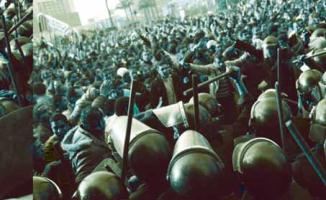
Many outcomes are possible across the ‘Arab Spring’.
PHOTO: REUTERS